
Self-love a feminist issue
Self-love is a feminist issue, and self-care is a radical act.
- Anjun Rahman
When I read this bold statement by Anjum Rahman, it naturally caught my attention.
Self-care and self-love are topics close to my heart, and ones I’ve written about many times before (e.g. Effectively Selfish, Compassionate Self-Care). Seeing them through a feminist lens can offer a different perspective—one that softens their strong association with selfishness.
The conditioning we carry
Anjum Rahman reminds us that a woman’s place has traditionally been defined through her relationships to others—not only in Asia or the Middle East, but also in the West.
We’ve been brought up to believe that, as women, we are meant to act selflessly, be considerate of other people’s needs, and work towards harmony—often at the cost of our own wellbeing. We may not have been told this outright, but many of us absorbed it nonetheless.
This conditioning runs deep. It shapes how we see ourselves and what we find acceptable.
Walking the edge between care and self-abandonment
It is not always easy to navigate the edge between caring and self-abandonment.
Am I a good friend if I say yes to a request when I’m already exhausted? Or can I acknowledge my friend’s need and still say no—with kindness, without guilt, and without feeling like I’m rejecting them?
Can I let go of what is not mine to solve, knowing it would drain my energy, even though I feel compelled to step in?
The truth is, the more we respect and honour our own needs, the more aligned and centred we feel—and the more resourced we are to respond to others with clarity and care.
When we override ourselves
When we ignore our needs—whether they show up as tiredness, frustration, irritation, or a sense of overwhelm—we create an internal misalignment that builds over time. We can lose connection to ourselves and feel unsure how to find our way back.
Over-committing or constantly prioritising others can quietly shape the nervous system into a pattern of over-giving, tension, and depletion—where caring for others feels easier than caring for ourselves.
Honouring our needs, on the other hand, builds internal steadiness, clarity, and alignment. It helps to gradually reset the nervous system and restores trust in our own signals and responses.
The courage to choose differently
And yes, choosing yourself can feel uncomfortable—it takes courage and trust.
It asks you to acknowledge that you are not superwoman, no matter how much you might wish to be. It asks you to take stock of what you can realistically offer in this moment. It asks you to acknowledge your humanness.
It invites you to accept yourself as you are—your needs, your limits, and your disappointments. Not as a fixed state, but as an honest starting point.
When we can care for and accept ourselves in this way, we are far more able to care for and accept others.
We become more compassionate, less judgmental, and more generous in how we think and act.
Most importantly, we begin to give from overflow, not from depletion.
A moment to reflect
• Where in my life am I trying to be kind at the expense of my own essential needs?
• What would it feel like to choose differently?
• What am I afraid might happen if I did?
Maybe self-care is less about adding more, and more about a willingness to honour our own needs and let go of what is not ours to carry.
Ngā mihi
Uschi
Food for Thought
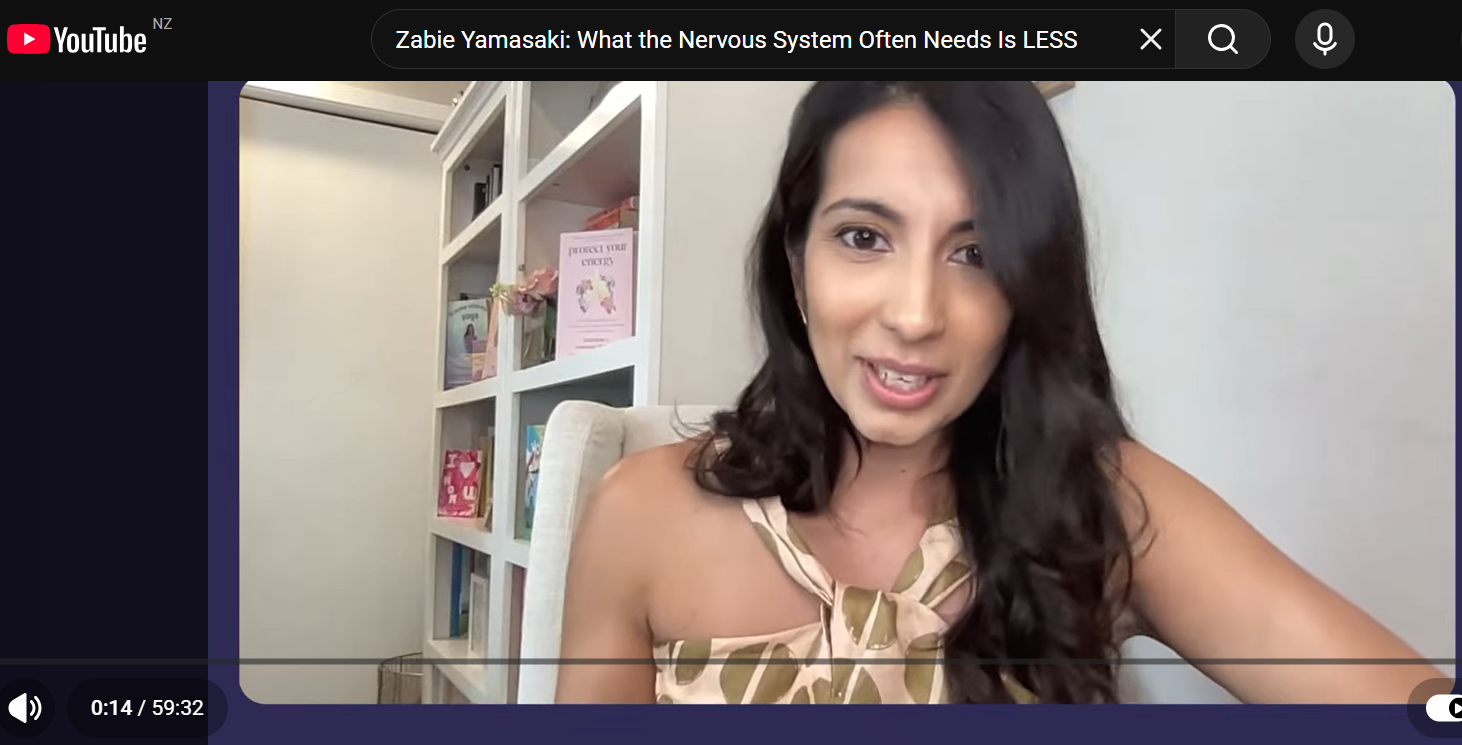
Zabie Yamasaki: What the Nervous System Often Needs Is LESS
In this episode, Tami Simon speaks with Zabie Yamasaki—founder of Transcending Trauma through Yoga, whose yoga-as-healing curriculum is now taught at over 50 universities including Stanford, Yale, and Johns Hopkins—about her new Sounds True book, Protect Your Energy: A Gentle Guide to Nurture Your Nervous System, Cultivate Rest, and Honor Your Needs. Drawing from her own journey through hypervigilance, burnout, and a series of panic attacks that landed her in the emergency room, Zabi brings both the science and the soul of nervous system healing.